Stories
Stories of the Prophets
The Quran tells the stories the Bible tells, and if you grew up with them, you are about to meet old friends. One message carried by many messengers: worship the one God, and live justly. These are their stories as Islam tells them.
Adam · Adam
The first man, honoured above the angels
Adam · Adam
The first man, honoured above the angels

The shared story The same Adam of Genesis, with one great difference: no original sin. Adam and Eve repented together, were forgiven together, and every child since is born clean.
God announced to the angels that He would place a steward (khalifa) on the earth, created Adam from clay, and breathed into him of His spirit. He taught Adam the names of all things, knowledge the angels did not have, and commanded them to bow to him in honour. All bowed except Iblis, who burned with pride: "I am better than him; You created me from fire and him from clay." (Quran 7:12)
Adam and his wife lived in the Garden with one boundary: a single tree. Iblis whispered to them both, and they both ate. The Quran is careful here: Eve is never blamed alone, and the pair respond not with excuses but with one of the most repeated prayers in Islam: "Our Lord, we have wronged ourselves; if You do not forgive us and have mercy on us, we will surely be among the lost." (7:23)
And God forgave them, fully, then sent them to the earth He had always intended them to steward. Their descent was a commission, not a curse. From their children (the Quran tells of Cain and Abel too) the human story begins.
The lesson Human beings fall, repent, and are forgiven; that cycle, not inherited guilt, is the Islamic story of our nature.
Noah · Nuh
Nine hundred and fifty years of patience
Noah · Nuh
Nine hundred and fifty years of patience

The shared story The flood, the ark, the pairs of animals: the story the Bible tells, told again with the spotlight on how much rejection one caller endured.
Nuh preached to his people for, the Quran says, nine hundred and fifty years (29:14). Night and day, publicly and privately, he called them to abandon their idols for the one God, and their reaction was to stuff their fingers in their ears and pull their cloaks over their heads (71:7). The elite mocked that only "the lowest people" followed him; Nuh refused to drive the poor believers away to win the rich.
When it was revealed that no one else would believe, God commanded him to build the ark, far from any water, while his people laughed at the old man hammering planks. He loaded pairs of the animals and the small band of believers. Then the sky opened and the earth gushed springs.
The Quran adds a devastating, intimate scene the Bible does not: Nuh's own son refused to board. "I will take refuge on a mountain," the young man called through the rain. "There is no refuge today from the command of God," his father cried, and the waves came between them (11:42-43). Even a prophet cannot force faith into the heart of his own child.
The lesson Keep doing the right thing without measuring it in results. Nuh's success was never the head-count; it was the faithfulness.
Abraham · Ibrahim
The friend of God, father of the prophets
Abraham · Ibrahim
The friend of God, father of the prophets

The shared story Judaism, Christianity, and Islam all claim Abraham, and Islam claims him precisely as the Bible describes him: the man who left everything for one God. Muslims pray blessings on him in every single prayer.
Ibrahim grew up in a city of idol-makers; his own father carved them. The Quran shows him reasoning his way to God as a young man, watching a star, then the moon, then the sun set in turn, and concluding: "I turn my face to the One who originated the heavens and the earth." (6:75-79)
He challenged his people with a famous piece of theatre: he smashed their idols, all but the largest, and hung the axe on it. "Ask the big one," he said, "if they can speak." Enraged, they built a bonfire and threw him in, and God commanded: "O fire, be coolness and peace upon Ibrahim." (21:69) He walked out untouched, and left his homeland for God.
Then came the test beyond tests: a dream commanding him to sacrifice his own son. He told the boy, and the boy answered, "Father, do as you are commanded; you will find me, God willing, among the patient." (37:102) As the knife touched, heaven called it off: the devotion was the point, and a ram took the boy's place. Islamic tradition holds this son was Ishmael (Isma'il), whom Ibrahim settled with his mother Hagar in the barren valley that became Makkah. Together, father and son raised the foundations of the Kaaba, praying: "Our Lord, accept this from us." (2:127) Eid al-Adha and the Hajj re-enact this family's story to this day.
The lesson Certainty is not the absence of tests but the willingness to be tested. God calls Ibrahim His friend (4:125); friendship with God is proven, not claimed.
Joseph · Yusuf
The most beautiful story in the Quran
Joseph · Yusuf
The most beautiful story in the Quran
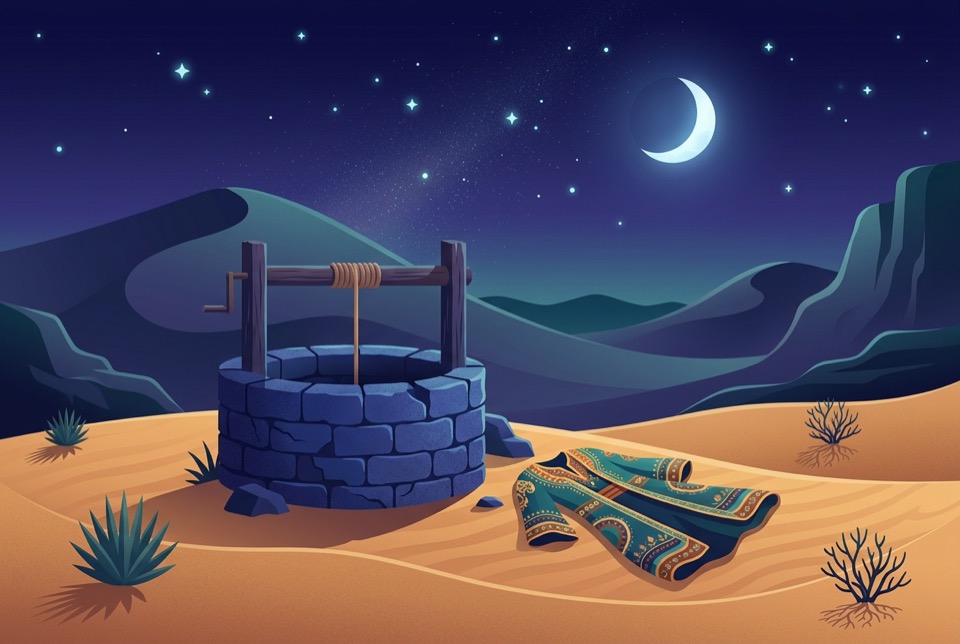
The shared story The coat, the jealous brothers, the well, Egypt, the dreams: the Joseph of Genesis, retold in a single sustained chapter (Surah 12) the Quran itself calls "the most beautiful of stories".
The boy Yusuf dreamed of eleven stars, the sun, and the moon bowing to him, and his father Yaqub (Jacob), a prophet himself, warned him not to tell his brothers. Jealousy had already curdled in them; they threw Yusuf into a well and brought their father the famous shirt stained with false blood. Yaqub's reply became the Muslim proverb for grief borne with faith: "Beautiful patience; and God is the one whose help is sought." (12:18)
Sold into Egypt as a slave, Yusuf grew into a man of striking beauty and total integrity. His master's wife tried to seduce him; he refused, and went to prison for years for the crime of innocence, a scene the Quran renders with piercing honesty: "My Lord, prison is dearer to me than what they invite me to." (12:33) In prison he interpreted dreams, and eventually the king's dream of seven lean cows devouring seven fat ones: famine was coming. Released and vindicated, he was made treasurer of Egypt and saved the nation.
Then his brothers came, begging grain, not recognising the official before them. Across several visits Yusuf tested and revealed himself, and forgave them completely: "No blame upon you today; God will forgive you." (12:92) The family, and the old blind father whose sight returned with joy, bowed before him: eleven stars, the sun, and the moon.
The lesson The well, the slavery, the prison: every apparent catastrophe was a step in the plan. "God is in full control of His affair, but most people do not know." (12:21)
Moses · Musa
The prophet mentioned most in the Quran
Moses · Musa
The prophet mentioned most in the Quran

The shared story The basket in the river, the burning bush, the plagues, the parted sea, Sinai: Moses dominates the Quran as he dominates the Torah. He is named over 130 times, far more than Muhammad ﷺ.
Pharaoh, warned that a son of Israel would end his reign, was slaughtering newborn boys. God inspired Musa's mother to set her baby in a chest upon the Nile, and it floated into the household of Pharaoh himself, where his wife Asiya (honoured in Islam as one of the greatest women of all time) rescued and raised him. His own mother was hired as his nurse: "So We returned him to his mother, that her eye might be comforted." (28:13)
Grown, Musa struck an Egyptian who was beating an Israelite and killed him, fled to Madyan, married, and shepherded for years, until, at the holy valley of Tuwa, a fire in a bush spoke: "Indeed, I am your Lord... I have chosen you." Commissioned with his brother Harun (Aaron) to confront Pharaoh, Musa asked first for something every anxious person has prayed since: "My Lord, expand my chest, ease my task, and untie the knot in my tongue so they may understand my speech." (20:25-28)
There followed the staff and the sorcerers, the plagues, and the night flight to the sea with Pharaoh's army behind. Trapped, his people cried "We are overtaken!", and Musa answered with pure tawakkul: "Never! My Lord is with me; He will guide me." (26:62) The sea split, the nation crossed, the tyrant drowned. Then Sinai, the Torah, the golden calf and the forgiveness after it; forty years of desert and lessons; and, in one of the Quran's most loved passages, Musa's journey with the mysterious sage al-Khidr, learning that God's plan hides mercy inside events that look senseless (18:60-82).
The lesson God's answer to every "I can't" in this story is company: "I am with you both; I hear and I see." (20:46)
Job · Ayyub
Patience with no expiry date
Job · Ayyub
Patience with no expiry date

The shared story The Job of the Bible: wealth, children, and health stripped away, and faith that would not break. Islam holds him up as the everlasting answer to "why do good people suffer?"
Ayyub had everything: lands, herds, family, health, and he was grateful. Then, as a trial from God, it was all removed: wealth ruined, children lost, and finally a disease so disfiguring that people withdrew from him. Years passed. His wife, who never left him, once asked why he didn't pray for relief; he answered that he had been given decades of blessing and would be ashamed to complain so soon.
When he finally called out, the Quran records the perfect etiquette of complaint, no demand, just honesty: "Indeed, adversity has touched me, and You are the Most Merciful of the merciful." (21:83) God answered: "Strike the ground with your foot"; a spring burst out, he washed and was healed, and his family and wealth were restored double, "as a mercy from Us, and a reminder for those who worship." (38:41-44)
The lesson "Indeed, We found him patient; an excellent servant, constantly turning back to God." (38:44) Suffering in Islam is not punishment by default; it can be the arena where the soul is proven.
Jonah · Yunus
The prophet who ran, and the prayer from the depths
Jonah · Yunus
The prophet who ran, and the prayer from the depths

The shared story Jonah, the ship, the great fish: identical to the Biblical account, and the source of a prayer Muslims say in every desperate moment.
Yunus preached to the city of Nineveh, despaired of them, and left without God's permission, boarding a ship that then met a storm. Lots were drawn for who should be cast overboard to lighten it; the lot fell on Yunus, again and again. Swallowed by the great fish, in the triple darkness of night, sea, and the creature's belly, he prayed the words every Muslim child learns: "La ilaha illa anta, subhanaka, inni kuntu minaz-zalimin"; there is no god but You, glory be to You, I was indeed in the wrong. (21:87)
"So We responded to him and saved him from the distress; and thus do We save the believers." (21:88) Cast ashore, healed under a gourd vine God grew over him, he returned to Nineveh, and found the whole city had believed: the only city in the Quran to repent entirely and be spared (10:98).
The lesson You can fail, flee, and still be a prophet; no darkness is too deep for the prayer of Yunus, and no person is too far gone to turn around.
Jesus · Isa
The Messiah, son of Mary, word from God
Jesus · Isa
The Messiah, son of Mary, word from God

The shared story The virgin birth, the miracles, the Messiah, the second coming: all affirmed in Islam. Where the faiths part is his divinity, and the Quran addresses the parting respectfully and directly.
The Quran devotes an entire chapter to Maryam (Mary), the only woman it names, and tells her story with reverence: her devout childhood in the temple, the angels' announcement that God had chosen her above the women of the worlds (3:42), and the visit of Jibreel with news of a son, "a word from God", conceived without a father: "He said: So it will be; your Lord says: It is easy for Me." (19:21)
She withdrew, and gave birth alone beneath a palm tree, and when she carried the baby back to her people's accusations, she pointed to the child, and the infant Isa spoke from the cradle: "Indeed, I am the servant of God. He has given me the Scripture and made me a prophet." (19:30) Grown, he healed the blind and the leper, and raised the dead, "by God's permission" (3:49), the Quran's constant refrain: mighty miracles, borrowed power.
Islam teaches that Isa was neither killed nor crucified, but that God raised him to Himself (4:157-158), and that he will return before the end of time, a belief Muslims and Christians share while understanding it differently. What the Quran asks of Christians it asks gently: to love Isa as the mightiest of messengers and servant of God, not as God (5:75). And it promises that of all people, the believers will find "the nearest in affection" to them are those who say "We are Christians" (5:82).
The lesson You cannot be a Muslim without loving Jesus. The two faiths' quarrel over him is, at heart, a shared devotion asking different questions.
The final chapter of this chain is told in the explore journey, and the first generation who carried it in the stories of the Companions.