Stories · The Seerah
The life of the Prophet ﷺ
One and a half billion people pattern their lives on this one, and most people outside Islam have never heard it told. Eight chapters, sixty-three years, faithfully to the sources, including the hard parts. Read it like a life, because it was one.
1 The orphan of Makkah · 570-610 CE
Forty years of character before a single verse
The orphan of Makkah · 570-610 CE
Forty years of character before a single verse
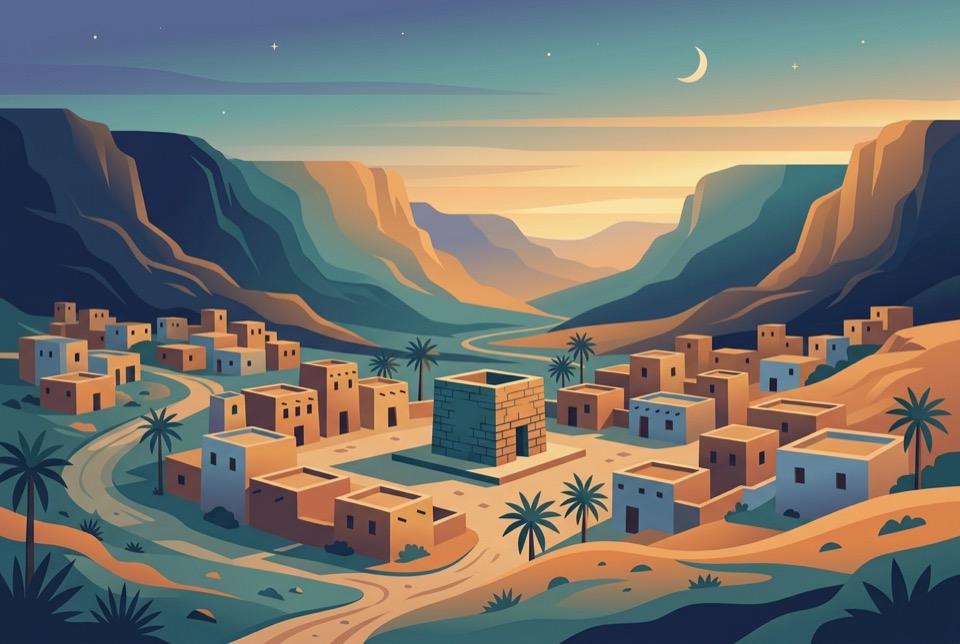
He was born into loss: his father Abdullah died before his birth, his mother Amina when he was six, his grandfather Abdul-Muttalib two years later. The orphan passed to his uncle Abu Talib, herded sheep for wages, and grew up in a Makkah that worshipped 360 idols around the shrine his ancestor Abraham had built for the One God.
What the city noticed about him was character. They called him al-Amin, the trustworthy, and as-Sadiq, the truthful, deposited their valuables with him, and asked him to arbitrate: when a dispute over who would replace the sacred Black Stone during the Kaaba's renovation nearly came to swords, he spread his cloak, set the stone on it, and had every clan lift a corner. At twenty-five, his honesty in trade so impressed his employer, the merchant Khadijah, that she proposed; their marriage of twenty-five years began, the refuge of everything that followed.
He was known for one more habit: withdrawing to a cave called Hira on a mountain outside town, to think. He was troubled by his city: its idols, its buried daughters, its poor crushed by usury. He was forty, and had never recited a line of poetry or claimed a vision in his life.
The lesson God trained His messenger in obscurity: bereavement, shepherding, honest trade, and a good marriage. The résumé of prophethood was character, and it was forty years long before the job began.
2 Read · 610-613 CE
The night the revelation began
Read · 610-613 CE
The night the revelation began

In Ramadan of his fortieth year, in the cave, something seized him. "Read!" said a presence, the angel Jibreel. "I cannot read," he answered, truthfully; the presence crushed him in an embrace and repeated the command, three times, then released the first words of the Quran: "Read, in the name of your Lord who created; created man from a clinging form. Read, and your Lord is the Most Generous, who taught by the pen; taught man what he did not know." (96:1-5)
He fled down the mountain trembling and fell into Khadijah's arms: "Cover me, cover me." When he told her he feared for himself, she gave the answer that made her the first believer: "Never! God will never disgrace you: you keep ties of kinship, you carry the weak, you provide for the destitute, you honour guests, and you help against the blows of fate." She took him to her Christian cousin Waraqa, learned in the scriptures, who declared: this is the same messenger-spirit that came to Moses; your people will drive you out. "Will they drive ME out?" he asked, astonished; no one in Makkah had an enemy fewer.
The revelation resumed and did not stop for twenty-three years. Quietly at first, the believers gathered: Khadijah; his ward Ali, aged ten; his freedman Zayd; his friend Abu Bakr, who believed without a moment's pause. A businesswoman, a child, a freed slave, and a merchant: the first congregation of Islam.
The lesson The first word of the final revelation was a command to read, given to a man who could not: from the beginning, this was to be a religion of learning carried by unlikely people.
3 The persecuted years · 613-619 CE
What Makkah did to the believers, and what he refused to do back
The persecuted years · 613-619 CE
What Makkah did to the believers, and what he refused to do back

When the preaching went public, "there is no god but God" read as an attack on Makkah's whole economy of pilgrimage idols and aristocratic privilege, and the city answered with force: the enslaved believers were tortured (Bilal under the boulder, gasping "One, One"; Sumayyah, the first martyr of Islam, an old woman speared by Abu Jahl), the Prophet ﷺ was mocked, strangled at prayer, and buried in camel entrails while he prostrated. Offered kingship, wealth, and women to stop, he answered his uncle: "If they placed the sun in my right hand and the moon in my left to abandon this, I would not, until God makes it prevail or I perish in it."
He would not fight; there was no permission for it, and for thirteen years the believers' only weapons were patience and emigration: he sent the weakest to the Christian king of Abyssinia, who heard the chapter of Mary recited, wept into his beard, and refused to surrender them. Makkah then besieged the Prophet's ﷺ whole clan in a ravine for three years under a starvation boycott; children's cries could be heard from the city.
The boycott broke, and then came the Year of Sorrow: Khadijah died, and Abu Talib died, and the protection of both was gone. He walked to the town of Ta'if to seek shelter and was stoned through the streets by its mobs until his sandals ran with blood. The prayer he made that day, recorded and beloved, complains only of his own weakness, asks nothing against the city, and ends: "if You are not angry with me, I do not care." An angel offered to crush Ta'if between two mountains. "No," he said. "I hope God brings from their descendants those who will worship Him alone." Ta'if's descendants are Muslims to this day.
The lesson Thirteen years of one-sided violence, and his record holds not a single act of retaliation: whatever came later came from a man who had proven he preferred to bleed than to curse.
4 The night journey, and the way out · 620-622 CE
From the lowest year to the ascension, and the pledge that changed everything
The night journey, and the way out · 620-622 CE
From the lowest year to the ascension, and the pledge that changed everything

At the bottom of the grief, the gift: in one night, the Prophet ﷺ was carried from Makkah to Jerusalem (the Isra), where he led all the prophets in prayer, and then ascended through the heavens (the Mi'raj), meeting Adam, Jesus, Moses, and Abraham, to a presence no creation had approached. From that night he brought back the five daily prayers, first commanded as fifty, reduced on Moses's repeated advice to five, "and they weigh as fifty": the believers' daily ascension, given at the messenger's lowest hour.
Makkah's mockery of the story became a sieve: it separated those who believed the man from those who had merely tolerated him. Abu Bakr, told his friend claimed to have reached Jerusalem overnight, answered: "If he said it, it is true," and earned the title as-Siddiq forever.
Meanwhile, at the pilgrimage seasons, the Prophet ﷺ kept preaching to visiting tribes, and men from Yathrib, an oasis town two hundred miles north, torn by generations of civil war between its tribes, listened. They believed, returned home, spread the message, and came back in growing numbers to make the Pledges of Aqaba: protect him as their own, obey in good, and welcome the believers. Yathrib would become Madinat an-Nabi, the City of the Prophet: Madinah.
The lesson The night journey is the pattern of the whole religion in one story: after the Year of Sorrow, the ascension. "Indeed, with hardship comes ease" was lived before it was recited.
5 The Hijra and the city · 622-624 CE
The migration, the constitution, and the brotherhood
The Hijra and the city · 622-624 CE
The migration, the constitution, and the brotherhood

Makkah, seeing the believers slipping away north, resolved to end it: one young man from every clan, one blade in every hand, so the blood-debt would drown among the tribes. The Prophet ﷺ left Ali in his bed as decoy, walked through the ambush reciting Ya-Sin, and vanished south, the wrong direction, with Abu Bakr, into a cave. The search party stood at its mouth; "do not grieve," he whispered to his weeping friend, "indeed God is with us" (9:40). The trackers turned away. Year one of the Muslim calendar dates from this flight: not from a birth or a victory, but from the night the truth had to emigrate.
Madinah received him with the closest thing Arabia had to a festival, and he set three foundations in his first months. A mosque, which he built with his own hands alongside the labourers. A brotherhood: each Makkan refugee formally paired with a Madinan helper who split home and livelihood with him, the Ansar whose generosity the Quran memorialised (59:9). And a constitution: a written charter binding the city's tribes, including its Jewish tribes, into "one community", with mutual defence, freedom of religion, and justice: among the earliest written constitutions on earth.
The penniless refugee of 622 was, within two years, the arbiter of a functioning city-state: teaching, judging, receiving revelation that now turned, alongside the eternal themes, to law, family, markets, and treaties. The religion was becoming a civilisation.
The lesson Islam counts time from the Hijra: the lesson baked into every Muslim date is that when a place will not let you live your truth, movement is worship, and building comes next.
6 The years of war · 624-627 CE
Badr, Uhud, and the Trench, honestly told
The years of war · 624-627 CE
Badr, Uhud, and the Trench, honestly told
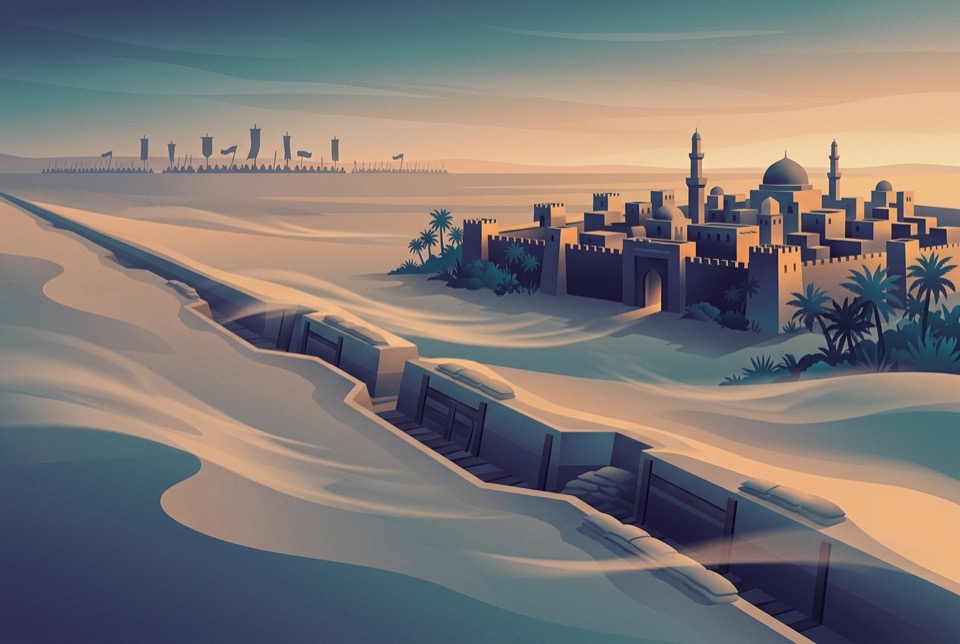
Makkah had not finished: it had confiscated the emigrants' property and intended to strangle the new city. Permission to fight, after fifteen years of pacifism under persecution, finally came down with its rationale attached: "Permission is given to those who are fought, because they were wronged... those who were expelled from their homes without right, only for saying: our Lord is God" (22:39-40). At Badr, 313 ill-armed believers met the Makkan army and, the Quran says, were aided by angels; the victory stunned Arabia. Among the prisoners, literate ones could ransom themselves by teaching Muslims to read: even war fed the religion of "Read".
A year later at Uhud came the wound: archers abandoned their posts for spoils, the tide reversed, seventy believers fell including the Prophet's ﷺ beloved uncle Hamza, and he himself was bloodied, tooth broken, in the melee. The revelation that followed did not spin the defeat; it audited it (3:152-155), and consoled: "do not weaken and do not grieve." Two years on, at the Trench, a ten-thousand-man confederacy came to erase Madinah entirely; on the Persian convert Salman's advice the Muslims dug a ditch the cavalry could not cross, endured a freezing month-long siege, and watched the coalition collapse in wind and hunger. (What followed the siege for the tribe that broke the defence pact was the ancient law of siege treason, judged by an arbiter of the tribe's own choosing; this site treats that hard episode honestly, in full, for those who come with questions about it.)
Through all of it, his standing orders bound the fighters: no killing of women, children, the elderly, or monks; no treachery; no mutilation; no destroying crops and wells. Set beside every other seventh-century army, and most since, the constraint was the innovation.
The lesson The Quran's war years produced defeat as well as victory, and scripture recorded both: a tradition that audits its own battles is claiming to be accountable, not triumphant.
7 The treaty and the opening · 628-630 CE
Hudaybiyyah's humiliating peace, and the conquest without revenge
The treaty and the opening · 628-630 CE
Hudaybiyyah's humiliating peace, and the conquest without revenge
In 628 the Prophet ﷺ marched, unarmed for pilgrimage, to Makkah's boundary, and negotiated the Treaty of Hudaybiyyah: terms so one-sided against the Muslims (turn back this year; return Makkan converts; ten years' truce) that his own companions were near mutiny, and it was Umm Salama's counsel that carried the moment. The Quran called the humiliating document "a clear victory" (48:1), and it was: the truce's two years of peace did what two decades of preaching under fire could not; Islam's numbers multiplied faster than in all the years before, and his letters went out to the emperors of Byzantium, Persia, and Egypt.
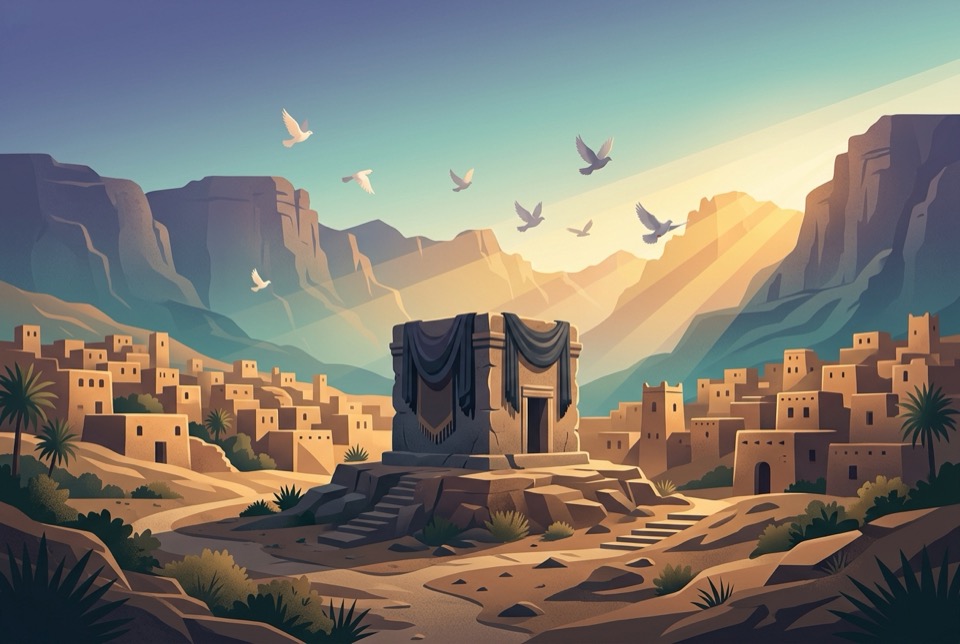
Makkah's allies broke the treaty with a massacre, and in 630 the Prophet ﷺ marched on his birthplace with ten thousand and took it almost without blood. The city that had tortured, starved, besieged, and exiled him waited for the sack that every ancient custom entitled him to. He entered bowed low on his camel in gratitude, cleansed the Kaaba of its idols while reciting "truth has come and falsehood has vanished" (17:81), and asked the assembled Makkans what they expected of him. Then: "Go, for you are free." A general amnesty, including for those with blood on their hands; Hind, who had mutilated his uncle Hamza's corpse, was forgiven upon her acceptance of Islam. Bilal, the once-tortured slave, climbed onto the Kaaba's roof and gave the call to prayer over the city.
The lesson Hudaybiyyah taught that a bad-looking peace can beat a good-looking war; the conquest taught what power is for. Twenty years of injury, answered with "go, you are free": that sentence converted more hearts than any army.
8 The farewell · 632 CE
The sermon, the death, and what remained
The farewell · 632 CE
The sermon, the death, and what remained

In the tenth year after the Hijra, he led the only Hajj of his life, and on the plain of Arafah addressed over a hundred thousand pilgrims with what he seemed to know was a goodbye: "I do not know whether I shall meet you again after this year." The Farewell Sermon distilled everything: sanctity of life and property; usury abolished; the devil despaired of; women's rights declared "a trust from God"; and the sentence that abolished tribal hierarchy: "no Arab is superior to a non-Arab, nor white over black, except by piety." Then revelation's closing seal came down upon him where he stood: "This day I have perfected for you your religion, completed My favour upon you, and approved for you Islam as a way" (5:3). Umar wept when he heard it; completion, he understood, means departure.
Months later, fever took him. He led prayers while he could, then sat propped watching Abu Bakr lead in his place, smiling at his community at prayer: the last public sight of him. His final counsels circled the prayer, the treatment of the weak, and "the prayer, the prayer, and those your right hands possess." He died at midday in Aisha's arms, in her room, owning almost nothing, his armour still pawned to a Jewish merchant for barley. He was sixty-three.
Umar, sword drawn, refused the news. Abu Bakr kissed his friend's forehead, went out, and steadied history with two sentences: "Whoever worshipped Muhammad, know that Muhammad has died. Whoever worships God, know that God is Ever-Living and never dies," then recited: "Muhammad is only a messenger; messengers have passed away before him" (3:144). He was buried where he died. What remained was what he had always said was the point: the Book, the example, and a community, now 1.9 billion, that prays exactly as he prayed and greets you the way he greeted: peace be upon you.
The lesson He died poor, in a borrowed corner of a mud-brick room, with the world's most complete claim on his followers' love. The measure of the man is that his community's deepest instinct at his name, fourteen centuries on, is still the one Abu Bakr protected: honour him, worship only his Lord.
The people around him: the Companions · His character in daily doses: the Seerah moment on your dashboard · The books behind this telling: sources